Plan your energy investments.
Prove every kWh saved.
Ento Strategy helps you build an optimized investment roadmap to reach your targets, verify the savings against your own meter data, and report on progress
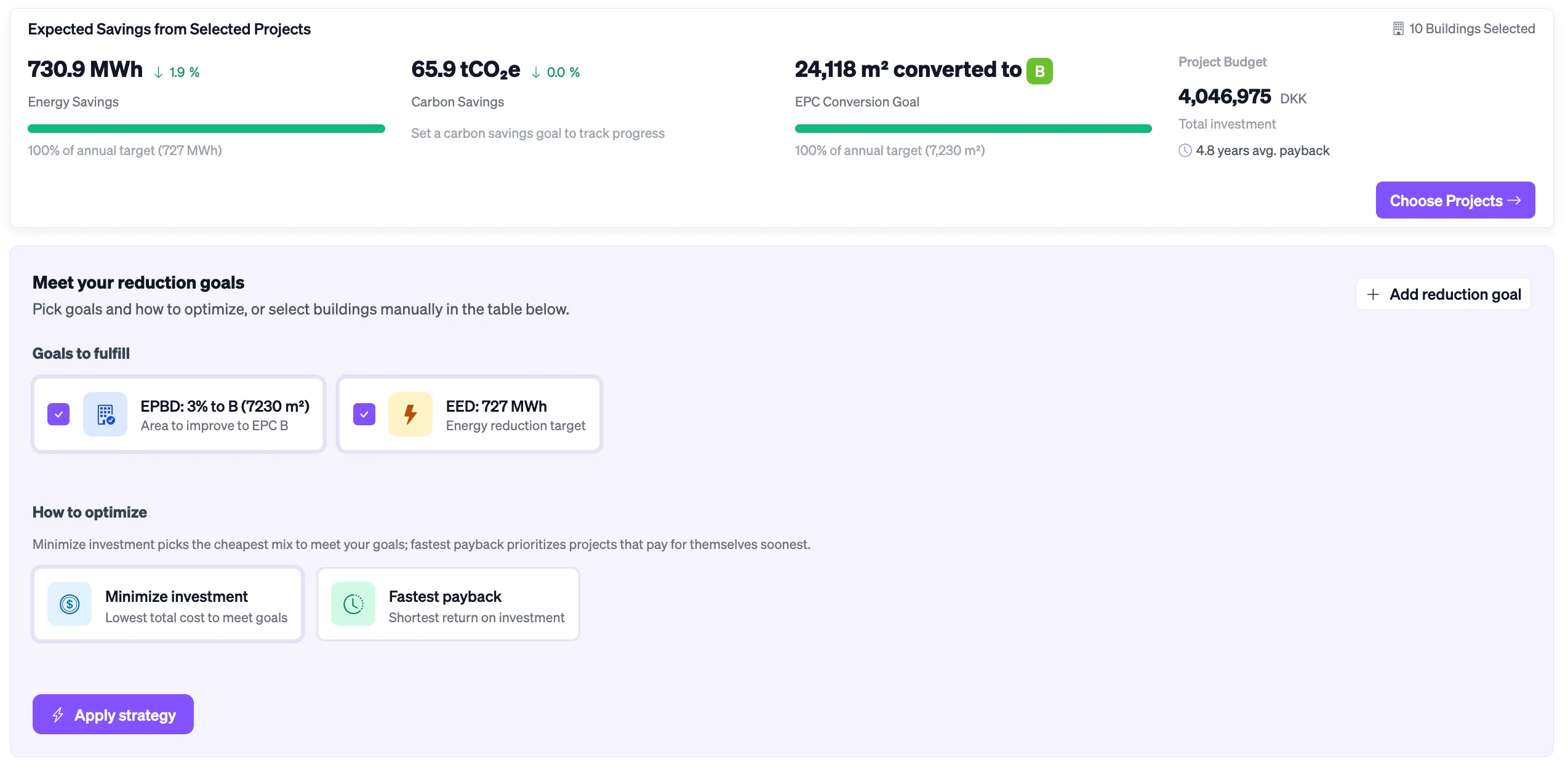
Turn regulations into live, trackable goals
Energy Performance Certificates improvement goals are connected directly to your uploaded energy audits, so Ento surfaces which buildings need to move up a rating class and suggests the top changes to get them there. Add your own custom energy and carbon goals alongside the regulatory ones, and see per goal how much of the gap your currently planned projects already cover.
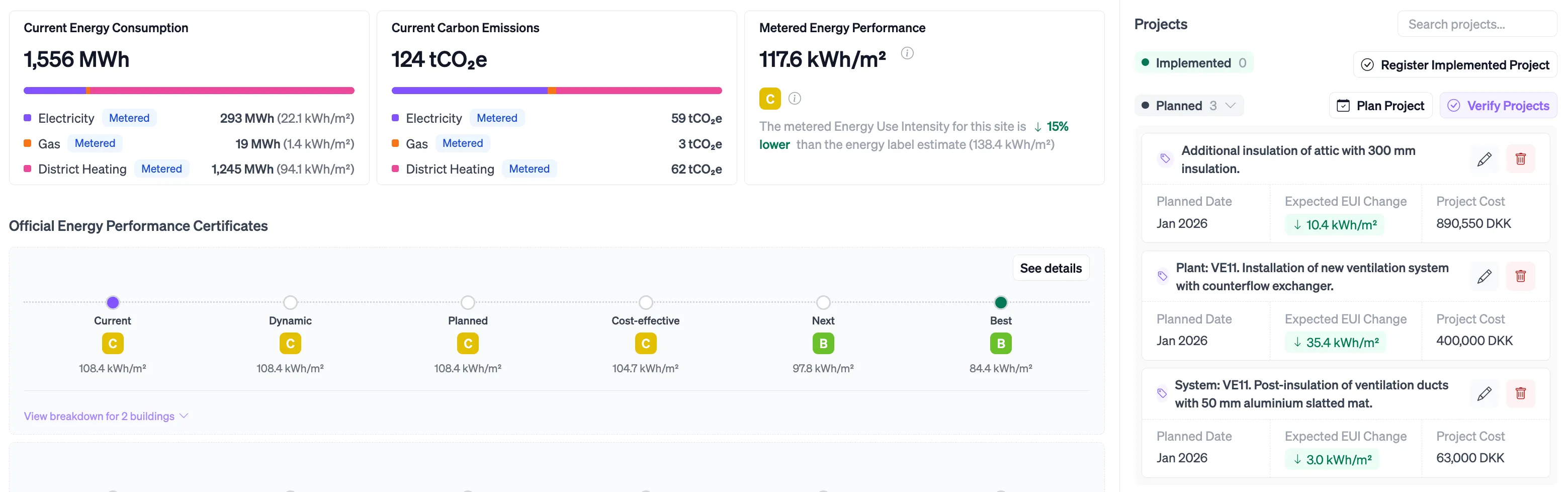
A plan built on how your buildings actually perform
Ento's optimizer then finds the best combination of projects across your portfolio, drawing from platform-simulated initiatives like PV or heat pump conversions, measures identified in your energy audits where available, and custom projects you've added yourself. PV systems are sized using satellite weather data and your actual electricity consumption, and every project is simulated alongside the others, so you see how PV, batteries and HVAC upgrades will interact before you commit.
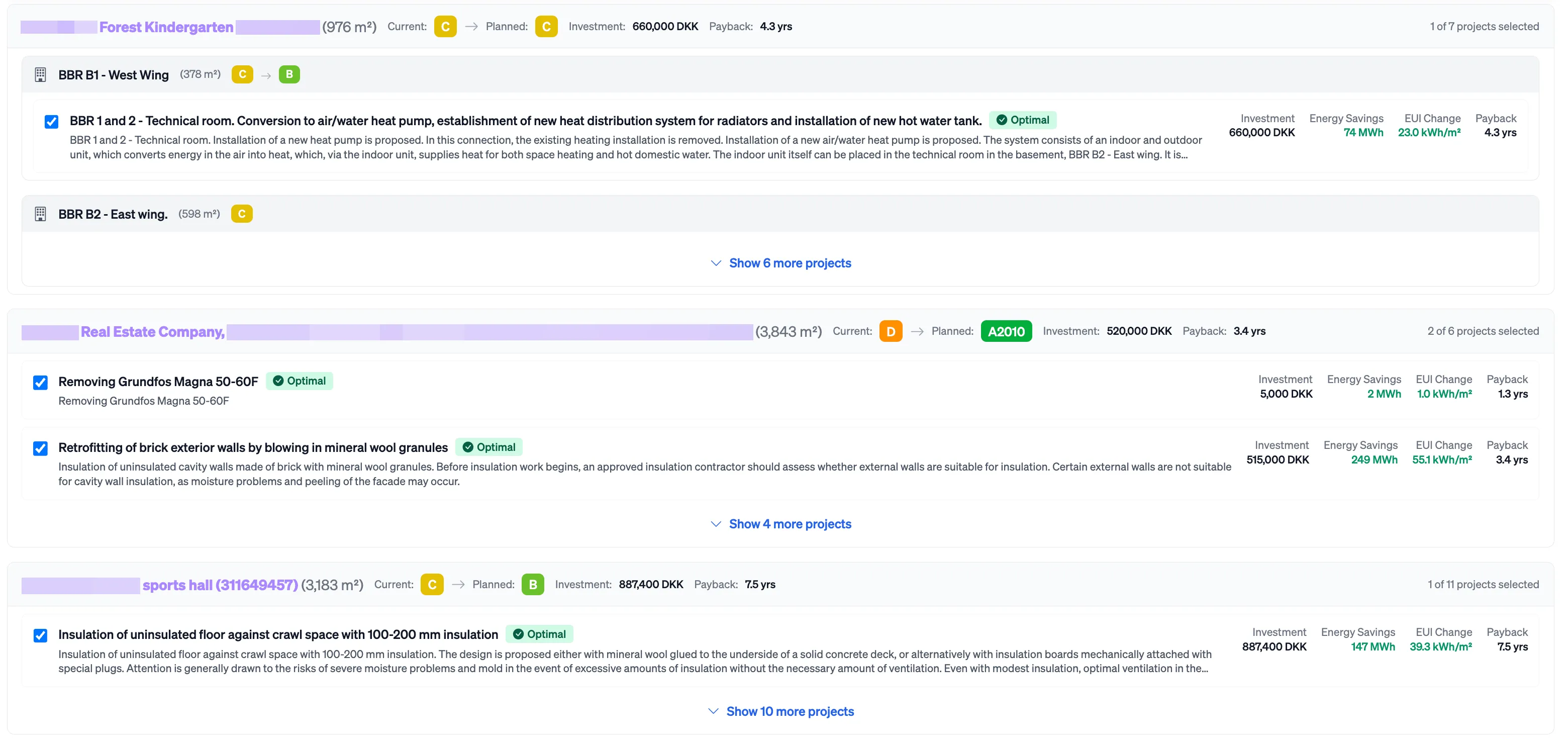
A continuously updated strategic roadmap
The optimizer refreshes the shortlist when conditions change. And once a project is implemented, Ento's Measurement & Verification module verifies the savings against real meter data, feeds the result back into your goal progress, and refines the assumptions your next plan uses. The roadmap you act on next year won't be the one you approved today, because by then you'll know more.
A dedicated model for every project type
Ento simulates each project with a purpose-built model, building an optimized investment roadmap that reflects how each system actually performs.
How building owners use Ento
to identfiy and verify savings

.png)
Start saving energy
- Discover hidden savings potential in your buildings
- Turn complex energy data into clear, actionable insights
- Measure impact and prove results with real-time reporting




%20(1).png)







%20(1).png)

Still got questions?
Which regulations does Ento Strategy support?
Strategy has first-class support for the EU Energy Efficiency Directive (EED) and the Energy Performance of Buildings Directive (EPBD), meaning the targets are built in, recompute automatically against your real data, and don't need to be maintained as spreadsheets. You can also set custom energy and carbon reduction goals alongside the regulatory ones, which covers most local or sector-specific obligations our customers face. If your organization is subject to a regulation we don't yet support natively, let us know. We prioritize adding regulations based on customer demand.
What if we don't have EPCs or energy audits for our buildings?
Ento Strategy works without them. The optimizer draws from three sources of candidate projects: platform-simulated initiatives that Ento models from your meter data and building metadata (PV, heat pump conversions, envelope improvements), any energy audits or EPCs you do have, and custom projects you add yourself. If you have audits in PDF format, Ento can process them and extract the proposed measures, even when they don't come from a national EPC registry. If you have no audits at all, the platform-simulated projects and your meter data are still enough to build an optimized plan.
How does Ento decide which projects to recommend?
The optimizer takes your candidate pool (platform-simulated projects, EPC-proposed measures where available, and custom projects you've added), combines it with your goals (EED, EPBD, custom energy or carbon targets), and solves for the subset of projects that best meets those goals under the criterion you choose: either minimize investment or fastest payback. You can constrain by budget, scope it to specific sites or buildings, and override any cost or savings assumption per project.
Can I compare different investment scenarios?
Yes. You can save multiple named scenarios side by side and compare their total investment, energy savings, carbon impact, project count and payback profile. Change the budget, swap which goals you're solving for, or adjust energy price assumptions, and see how the optimal plan shifts. This is especially useful for building a business case: a "minimum compliance" scenario next to an "ambitious decarbonization" scenario, with real numbers on both, makes the tradeoffs visible rather than theoretical.
How does Ento Strategy know if our planned savings are actually being achieved?
Once a planned project is marked as implemented, it hands over to Ento's Measurement & Verification module, which uses the same meter data to verify the savings against a counterfactual of what the building would have consumed without the project. Verified savings flow back into your goal progress automatically, so your "are we on track" numbers reflect reality, not just estimates. You can read more on the M&V page.
How do you quantify & verify the savings?
As soon as you mark a project as complete, the calculations for verifying your savings start running in the background.
The process is different for each type of initiative, however, in general we use real consumption data from your buildings, physical simulations, and machine learning models to simulate the impact of different actions within the buildings.
Can we use Ento Strategy for compliance reporting?
Yes. Goal progress, verified savings and EPC inventory are continuously updated and exportable, which gives you a structured evidence trail for audits, regulatory filings, ESG reports and internal stakeholder communication. Because the underlying numbers are driven by meter data and IPMVP-aligned verification, the same data that proves savings internally can back up what you report externally, including for frameworks like ISO 50001.
What happens if our targets change, or a new regulation comes into force?
Goals are configurable, not hardcoded. You can adjust the annual reduction percentage, shift the baseline year, change the target year, or swap which sites a goal applies to, and the progress calculations recompute live. When new regulations come into force that affect our customers, we add first-class support for them to the platform. Custom goals are always available as an escape hatch in the meantime.
Do we need to model every project ourselves, or does Ento do it?
Ento models the most common project types for you. PV is sized using satellite weather data and your actual electricity consumption. Heat pump conversions use piecewise COP-vs-temperature curves fit to real performance data. Envelope and other HVAC improvements are based on EPCs and energy audits where available, with standard assumptions where not. For anything Ento doesn't simulate natively, you can add a custom project with your own cost and savings estimates, and it gets optimized alongside everything else.
How does Ento Strategy work with the rest of the Ento platform?
Ento Strategy runs on the same meter data backbone as Ento Advisor and Ento's M&V module, which means the three close a loop. Advisor detects waste and operational issues that Strategy can turn into candidate projects. Strategy plans the investments that hit your targets. M&V verifies the savings once projects are implemented, and those verified results feed back into your goal progress and sharpen future planning assumptions. You don't have to use all three, but each one gets more valuable when it's connected to the others.